Para Español:
Search
-
-
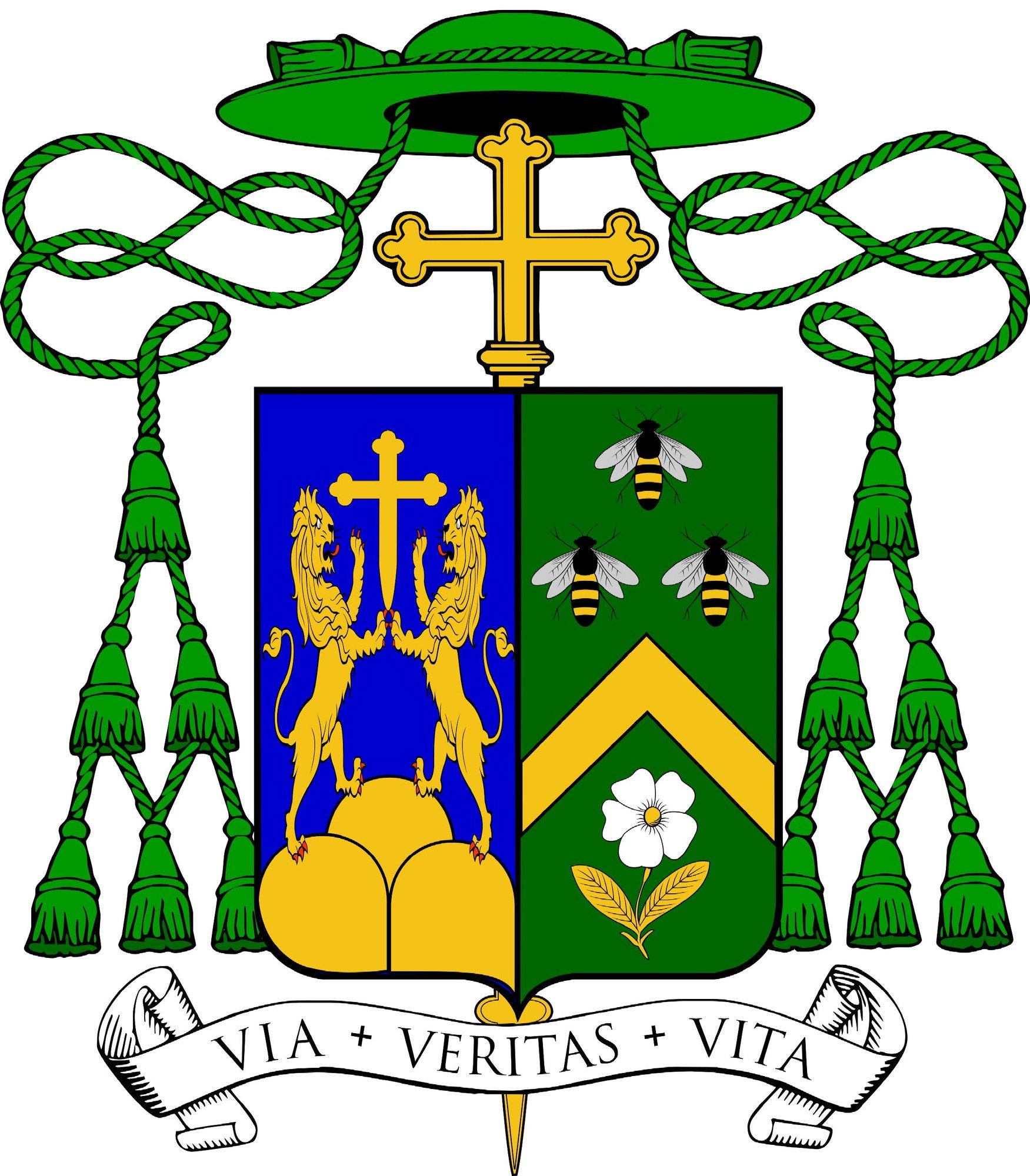
Heraldic Achievement ofMost Reverend Thomas Joseph HennenSeventh Bishop of Baker
“The Way, the Truth, and the Life”
John (14:6)
In designing the shield — the central element in what is formally called the heraldic achievement — a bishop has an opportunity to depict symbolically various aspects of his own life and heritage, and to highlight aspects of Catholic faith and devotion that are important to him. The formal description of a coat of arms, known as the blazon, uses a technical language, derived from medieval French and English terms, which allows the appearance and position of each element to be recorded precisely.
A diocesan bishop shows his commitment to the flock he shepherds by combining his personal coat of arms with that of the diocese, in a technique known as impaling. The shield is divided in half along the pale or central vertical line. The arms of the diocese appear on the dexter side — that is, on the side of the shield to the viewer’s left, which would cover the right side (in Latin, dextera) of the person carrying the shield. The arms of the bishop are on the sinister side — the bearer’s left, the viewer’s right.
The Diocese of Baker was established in 1903 by Pope Leo XIII, comprising the 18 counties of Oregon east of the Cascade Mountains. The founding bishop was Most Rev. Charles J. O’Reilly, and the arms of the Diocese were based on those of the oldest O’Reilly clan in Ireland. The seventeenth-century Irish arms depicted two gold lions on a green background, holding up a human right hand, a reference to a medieval legend about the settling of Ireland.
In the diocesan arms, designed by the American heraldist Pierre de Chaignon La Rose (1871-1941), the lions instead hold a Cross with a pointed base (cross bottony fitchée). Traditionally, the Diocese describes the lions as representing Pope Leo XIII (whose name means “lion”), and Bishop O’Reilly. The rounded arms of the cross resemble Saint Patrick’s shamrock, a symbol of the Most Holy Trinity, and the pointed base refers to the “planting” of the Catholic Faith in the mission territory. The green background is exchanged for blue (azure), which together with three gold mounds at the base of the shield allude to the mountainous terrain of eastern Oregon.
The Bishop’s personal arms are primarily green and gold, colors reminiscent of the fields of his home state of Iowa. Green is associated with growth, vitality and the virtue of Hope, and the Bishop was appointed and ordained in the Jubilee of the Year 2025, “a Holy Year marked by the hope that does not fade, our hope in God.”
The gold chevron in the center of the shield resembles a carpenter’s square. This has traditionally been used as an attribute of the Bishop’s two baptismal patron saints: Saint Thomas the Apostle, and Saint Joseph, the husband of the Blessed Virgin Mary. It also recalls the chevron in the arms of the Diocese of the Bishop’s home diocese of Davenport, where he served as a priest for twenty-one years.
Below the chevron — protected by it, as it were — is a rose, symbolic of the Blessed Virgin Mary. In this case the particular type depicted is a “wild rose” or “prairie rose” (Rosa arkansana), which is native throughout the Midwest and was designated the state flower of Iowa in 1897. The white petals of the flower allude to the purity of the Blessed Virgin, and its gold seeds, stems and leaves are fitting for a symbol of the Queen of Heaven.
Above the chevron appear three bees, attributes of Saint Ambrose, the fourth-century Bishop of Milan. According to legend, when Ambrose was a baby, a swarm of bees landed on him without harming him, leaving behind a drop of honey on his head. His parents interpreted this as a sign that he would possess great wisdom and intelligence. Because of his eloquence in preaching and teaching he is numbered among the four great Doctors of the Latin Church. Bishop Hennen is an alumnus of Saint Ambrose University, in Davenport, and served as its chaplain for four years. He is currently a member of the university’s Board of Trustees.
Among those influenced by Saint Ambrose was another future Doctor of the Church, the great Saint Augustine. After his conversion in Milan in 380, Augustine returned to his home diocese of Hippo in northern Africa, where he became its Bishop. Preaching on the Octave of Easter (now also known as Divine Mercy Sunday), he spoke to the newly-baptized members of the congregation about their relationship with God, with the Church, and with their Bishop. The images in his sermon connect well with the arms Bishop Hennen has chosen at the beginning of his own service as Bishop:
I speak to you who have just been reborn in baptism, my little children in Christ, you who are the new offspring of the Church, gift of the Father, proof of Mother Church’s fruitfulness. All of you who stand fast in the Lord are a holy seed, a new colony of bees, the very flower of our ministry and fruit of our toil, my joy and my crown.
On a scroll below the shield is a phrase from the Gospel according to Saint John: Via, Veritas, Vita. It comes from the Last Supper, an exchange between the Lord Jesus and his apostle: “Thomas said to him, ‘Lord, we do not know where you are going. How can we know the way?’ Jesus said to him, ‘I am the way, and the truth, and the life. No one comes to the Father except through me’” (John 14:5–6). The Bishop has chosen this phrase as a motto for his apostolic work, especially the missionary discipleship and evangelization which announces the truth of Christ to all, setting them on the way that leads to eternal life.
The shield is ensigned with external elements that identify the bearer as a Bishop. A gold processional cross appears behind the shield. The galero or “pilgrim’s hat” is used heraldically in various colors and with specific numbers of tassels to indicate the rank of a bearer of a coat of arms. A bishop uses a green galero with three rows of green tassels.
Arms devised by Rev. Philip Bochanski
PDF to download or print
-